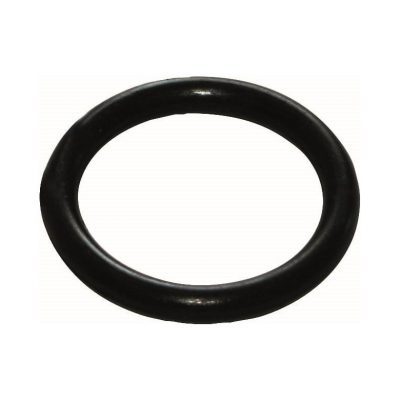
An O-ring, also known as a rubber sealing ring, O-ring seal or sealing ring, is the most widely used sealing solution in the world. This ring-shaped seal is used in countless hydraulic, pneumatic, and mechanical systems to prevent leakage of fluids and gases. O-rings are easy to manufacture, simple to install, and extremely reliable in use. The size of an O-ring is determined by its inside diameter (ID) and cord thickness (CS). Techniparts supplies O-rings of nearly every brand, size, and material, available in metric, inch, and standard AS568 dimensions, with fast delivery or a suitable alternative when a specific type is not in stock.
NBR, FKM (Viton / FPM), EPDM, HNBR, MVQ (Silicone), FVMQ (Fluorosilicone), ACM (Polyacrylate), FFKM (Kalrez, Chemraz, Parofluor), IIR (Butyl), CR (Neoprene), AU (Polyurethane)
Hydraulic systems, pneumatic systems, pumps, valves, compressors, couplings, and general industrial sealing applications.
Niels Christensen invented the O-ring while working on automotive brake systems. He received a patent for the O-ring in 1937, but manufacturers showed little interest until World War II. He then sold the design to the military. This “simple” O-ring helped complex technologies advance rapidly. Today an EPDM O-ring—as well as many other elastomers—is indispensable in modern engineering.
The O-ring is currently the most widely used seal in the world. It is relatively easy to manufacture and install.
The size of an O-ring is specified by the inner diameter (ID) and the cross-section (CS).

O-rings are available in different elastomers (rubber types) and hardnesses (Shore).

KTW, USP, NSF 51/61, WRC, WRAS, FDA, R67-01.
We can also supply O-rings with a coating to aid assembly or reduce friction. Coating options: silicone grease, PTFE (Teflon), Molykote, talc.
Also available: O-rings compliant with RoHS (Restriction of Hazardous Substances), REACH (Registration, Evaluation, Authorisation and Restriction of Chemicals), and standards such as MIL-R and NAS.
NBR O-rings, FVMQ (fluorosilicone) O-rings, EPDM O-rings, HNBR O-rings, FKM/FPM (Viton) O-rings, MVQ (silicone) O-rings, ACM (polyacrylate) O-rings, FFKM (Kalrez / Chemraz / Parofluor) O-rings, IIR (butyl) O-rings, CR (neoprene) O-rings, AU/PU (polyurethane) O-rings. EPDM O-rings are very common thanks to their excellent properties.
The right rubber compound depends on the media it contacts. We’re happy to help you choose and can also perform failure analysis on O-rings.
We supply the correct O-ring for exposure to sunlight, ozone, UV radiation, fuels, gas, LPG R67, diesel, gasoline, water, drinking water, oil, grease, kerosene, hydrocarbons, hydrogen, alcohols, acids, alkalis, chlorine, and for FDA food contact. We also supply silicone-free (100% silicone-free) O-rings for applications in glass, glass industry, automotive, etc.
All brands of O-rings: Trelleborg Busak & Shamban, Dichtomatik, James Walker, Guarnitec, Rada, Parker Prädifa, Angst & Pfister, Hitec Normatec, Eriks, Freudenberg Simrit, Ebele sealing, Snijders, NOK, Kimman, Greene Tweed, DuPont, Profiltra, Skega, Dowty. O-ring(s), O-ringe.
This fluoroelastomer is used where O-rings must withstand high temperatures and aggressive chemicals. FKM/FPM (Viton®) seals are common in aerospace, automotive and other machinery requiring maximum resistance to heat and a wide range of media.
NBR O-rings are made from a copolymer of acrylonitrile and 1,3-butadiene. Properties depend on the acrylonitrile content (typically 18%–50%). Higher ACN increases resistance to petroleum-based oils and hydrocarbon fuels but reduces low-temperature flexibility and can make the rubber brittle.
Dow Corning (a joint venture between Dow Chemicals and Corning Glass Company) was the first to produce silicone rubber; General Electric began production in 1947 and patented its process. VMQ O-rings are a family of elastomers based on silicon, oxygen, hydrogen and carbon. In general, silicones have modest tensile, tear and wear resistance. Special compounds offer exceptional resistance to heat and pressure cycling; very strong grades exist, though not as strong as many conventional rubbers.
See our O-ring webshop for additional materials.
Use our O-ring calculator to compute cord length and inner diameter—handy for identifying the correct size.
There are many reasons an O-ring can fail—often due to incorrect sizing versus groove dimensions. On our webshop you’ll find typical failure modes, prevention tips and recommended solutions.
Our guide helps you check which compounds withstand specific chemicals so you can select the right O-ring.
We work closely with a leading European O-ring laboratory and test facility to offer hardness, tensile and other tests. See our testing services for details.
Find more services and tools we provide.
Order our round cord here as well.
Receive personal advice or a tailored quotation from our product specialists. Fill in the form and discover which O-rings best fit your needs.



 Nederlands
  Deutsch